Mr. Armani does not seem to tire. The designer presented two collections during Milan Fashion Week and also put on a photo show in his Armani/Silos on Guy Bourdin. First conceived as an exhibition space – by Tadao Ando – dedicated to his own body of work, he has recently switched gears and decided to make the Silos a contemporary photography space. Recent shows include “Heimat” by Peter Lindbergh and “Magnum Photos – Colors, Places, Faces” curated by Armani in collaboration with the famous photo agency. We caught up with Mr. Armani and his newly opened exhibition on French fashion photography legend entitled “Guy Bourdin – Storyteller”. Who has time to answer so many questions while putting on his fashion shows? Mr. Armani does.

Guy Bourdin, portrait – © 2023, The Guy Bourdin Estate
ACHTUNG: Why Guy Bourdin?
Mr. Armani: Because I admire his work, particularly his almost obsessive attention to detail combined with his extraordinary use of colour. These are the elements that differentiate his work from that of any other photographer. Bourdin started out as a painter, which is clear in the way he approaches the image: no detail is left to chance and the shot is meticulously studied so that the composition is impeccable in every aspect. And then there is that sense of narrative urgency behind every image. Bourdin loved cinema, noir above all and Hitchcock in particular, and this is immediately conveyed because his images evoke detective stories or mysterious thrillers to which a solution is never revealed. We can only imagine or guess. This ability to evoke is an unmistakable trait of his, in my opinion, and it forces us to look closely for clues, which are then left to germinate in the imagination.
A: Do you remember the first time seeing his work? How did it make you feel?
MA: I never met him, but I confess that when I first started out working in fashion and with photography, I admired him from afar. It was admiration mixed with hesitation as his work was characterised by a powerful sensuality and extremely vivid colours, very different to my own language. But over time, I’ve learned to let myself be intrigued by what is different, to the point that I am attracted by it.
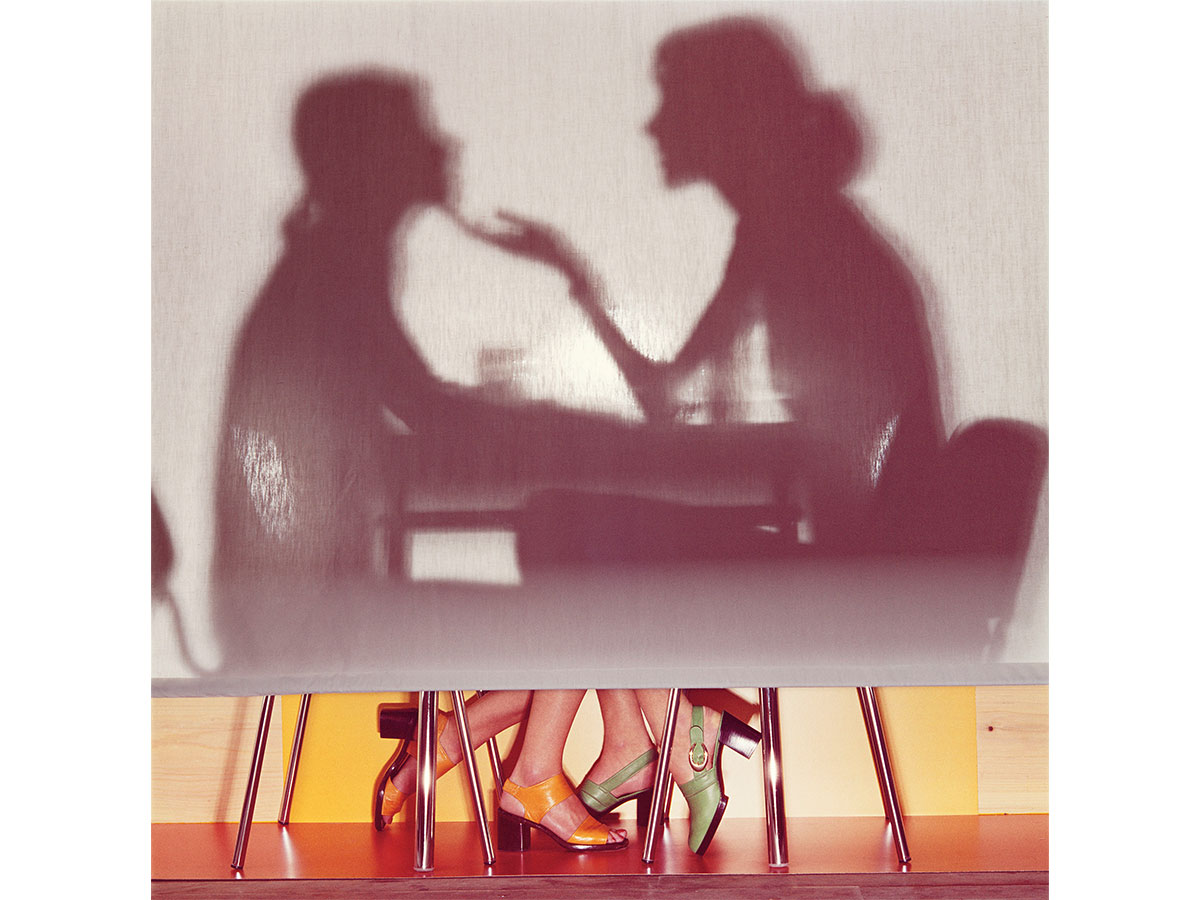
Charles Jourdan, 1972 © 2023, The Guy Bourdin Estate
A: What do you consider Bourdin’s biggest impact on fashion photography?
MA: First and foremost, he was a storyteller, and it is this quality that he brought to fashion photography – the idea that as well as producing an aesthetic image, you could also suggest a narrative context that intrigues the viewer. Indeed, for him the product was secondary to the image, which was a bold progression in fashion photography at the time. In this way, he modernised fashion photography, bringing a fresh perspective. But though his lens was contemporary, he also managed to draw from the past – he was heavily influenced by the surrealists and was a close friend of Man Ray’s. The often disconcerting eye of the surrealist is present in much of his work, where he engages our attention through the use of the unusual and uncanny.
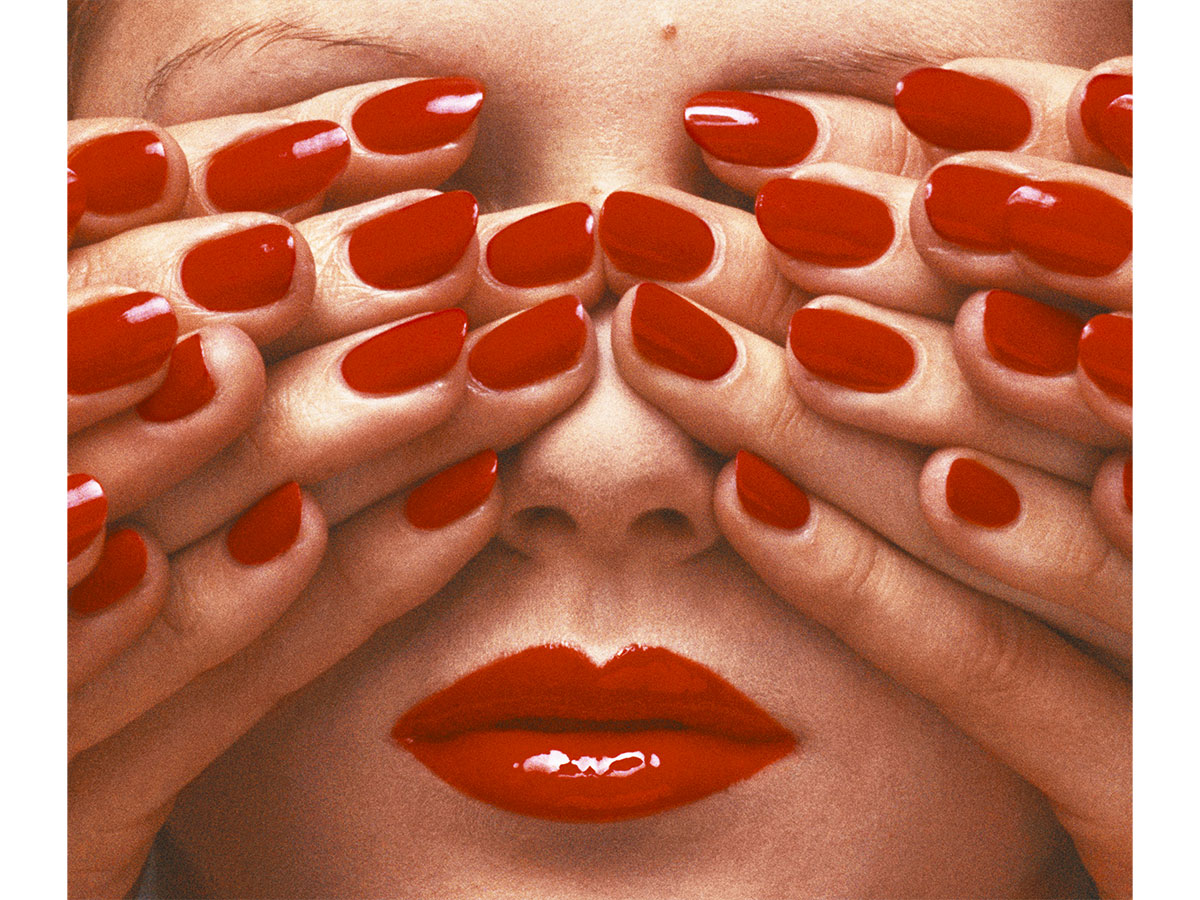
Vogue Paris, May 1970 © 2023, The Guy Bourdin Estate
A: Where do you see the biggest change in fashion photography since Bourdin?
MA: Fashion photography is now a broad genre with so many different approaches and practitioners that it is hard to generalise. But Guy Bourdin was experimental, really pushing the boundaries of fashion photography, and for that reason his shots are unforgettable, immediately recognisable, and forever imprinted in the collective imagination. He was also a meticulous artist, creating sets, cropping inventively, using hyper-real colour. Even when he shot outside his studio in the Rue des Ecouffes in le Marais he managed to construct imagery that is striking and original, converting the real world into a construct of his creativity.
A: What makes Guy Bourdin’s work related to Armani?
MA: This exhibition is really a testament to my vision for the Armani/Silos as a centre of contemporary photography that is able to embrace both image makers related to the Armani world as well as those that couldn’t be further from it. At first glance, Guy Bourdin is not an artist with whom I have a lot in common: his language is clear-cut, graphic and impactful. And, of course, a sense of provocation is immediately evident in his work. But what strikes me the most – and what I wanted to focus on – is his creative freedom, his narrative skill and his great love of cinema, all of which are very Armani! Bourdin did not follow the crowd and he did not compromise, and I identify with that. I don’t believe that there is any other way to make a mark on the collective imagination.

Invite for MAF!A AD Agency, 1972 © 2023, The Guy Bourdin Estate
A: Was any of your work inspired by him in particular?
MA: Not specifically. But there is something in his painter’s eye that speaks to me. He was a painter before he established himself as a photographer, and I know, for example, that he admired Edward Hopper. In those mysterious paintings by the American, with their atmospheric moods, there is something of Armani. It’s to do with mystery and intrigue. With not giving too much away. With suggestion. That is where I have an aesthetic affinity with Guy Bourdin, even though his use of bold colour, for example, might suggest otherwise.
A: Bourdin is know for narrative photography – what is the storyline of the Guy Bourdin exhibition?
MA: It’s all about giving the visitor an immersive experience. With the Guy Bourdin Estate, I have selected 100 photographs, including both iconic shots and lesser-known images. I’ve chosen to display these in rooms that mirror the photographer’s use of saturated colours – entire rooms of reds, greens and pinks. There are also 21 black-and-white photographs to show how expert was his expressive ability when working with the simplest of contrasts. Another section explores his love of cinema and features a selection of advertising campaign images showing what appear to be crime scenes or police chases. The story you see unfold at the exhibition is that of one man’s imaginative world, which exists on the borders of the absurd and the sublime, and that manages to effectively stimulate the spectator’s subconscious.

Vogue Paris, May 1984 © 2023, The Guy Bourdin Estate
A: What’s your favourite photograph in the exhibition? Why?
MA: There are many I like, but one in particular stands out. It is of the back of a woman’s head and shoulders and she appears to be wearing a bright red hat and a black dress with peaked shoulders. All you see of her is her neck and upper back. It’s not clear what the garments are, nor is it entirely obvious that this is indeed a rear view. The whole composition is a mystery, the red and black forming a striking graphic contrast and the human pictured entirely hidden.
A: What was Bourdin’s perception of womanhood?
MA: I think he was intrigued by the noir-ish vision of women as mysterious and intriguing.

A: What would you like visitors to take away from the exhibition?
MA: I’d like them to be reminded that the creative spirit is a mercurial and surprising genie that manifests itself in many different ways. And that here, in Guy Bourdin, we see such a spirit at work, or maybe I should say, at play. I hope the exhibition portrays his compositional and narrative intent and moves appreciation of his work beyond the well-worn debate about its provocative element, which, though undeniable, is only part of the story. I want to show how Bourdin’s desire was to prioritise image creation, not product, and how he remained unwaveringly true to his principles; and also how he created, through his use of hyperreal colours, plays of light and shadow, and glossy make-up on the models, a unique, distinctive visual code. We are living in an age in which countless images are produced yet often risk leaving no trace. But Bourdin’s work still has a lot to teach anybody who produces images today and the audience who consumes them. And I believe that is worth celebrating.
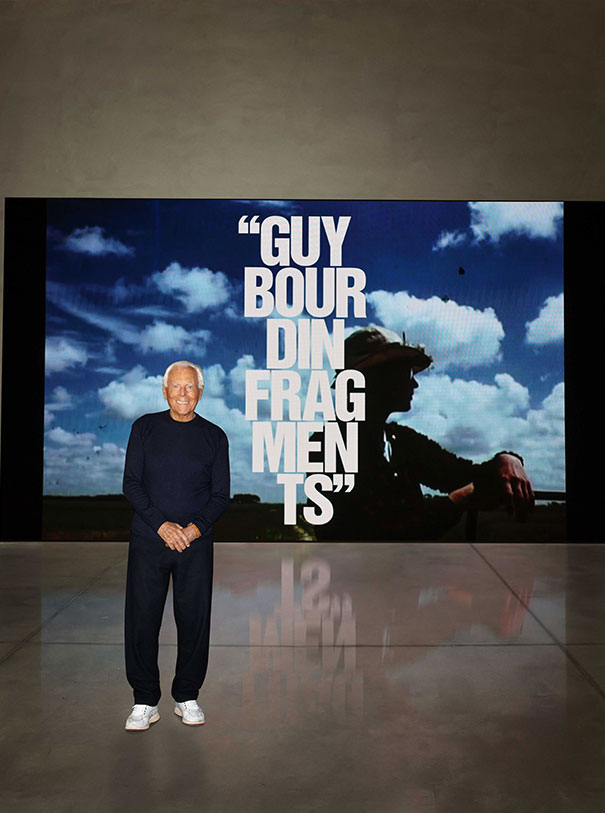
Giorgio Armani – Courtesy of Giorgio Armani